Planned Future

Financial wellness topics for employees

Financial wellness topics for employees

Financial wellness topics for employees

Discover the key financial wellness topics for employees in our latest blog to help support employee wellbeing.

Financial wellbeing has become a core part of modern workplace strategy. As organisations look to support productivity, retention, and overall employee health, financial education is increasingly recognised as a critical pillar.

Employees are not only dealing with rising living costs but also navigating complex decisions around pensions, debt, savings, and long-term planning. Providing structured, relevant financial wellness topics for employees can help bridge knowledge gaps and reduce financial stress.

At Planned Future, financial wellbeing is approached as a practical, accessible service that empowers employees to make informed decisions. This article explores the most impactful financial wellness topics for employees, how they support workplace outcomes, and how employers can implement them effectively.

Financial wellness topics for employees

Why financial wellness matters in the workplace

Financial stress is one of the leading causes of anxiety among UK workers. According to research from the Money and Pensions Service, millions of adults lack confidence in managing their finances, with many unable to withstand even a small financial shock. This has a direct impact on workplace performance, increasing absenteeism, reducing productivity, and contributing to higher staff turnover.

Employers that invest in financial education are seeing measurable benefits. Financially confident employees are more engaged, more focused and better equipped to plan for the future. A structured approach to financial wellness topics for employees helps create a culture of support while also aligning with broader wellbeing initiatives.

Budgeting and day-to-day money management

A strong foundation in budgeting is essential for financial stability. Many employees struggle not because they lack income, but because they lack clarity on how to manage it effectively. Teaching employees how to track income and expenditure, prioritise essential spending, and build sustainable habits is one of the most valuable starting points.

Workshops focused on budgeting should go beyond theory. Practical tools such as cash flow planning, digital budgeting apps, and real-life scenarios make the learning more relevant. When employees gain control over their day-to-day finances, it often reduces immediate stress and builds confidence in handling more complex financial decisions.

Recommended Workshop: Foundations in Personal Financial Planning

  • Online or onsite
  • 1 hour (with Q&A)


Managing debt effectively

Debt is a significant concern for many employees, particularly in periods of economic uncertainty. Credit cards, personal loans, and buy-now-pay-later schemes can quickly become overwhelming without a clear repayment strategy.

Financial wellness programmes should include education on different types of debt, interest rates, and prioritisation methods such as the snowball and avalanche approaches. Employees benefit from understanding how to consolidate debt where appropriate and how to avoid high-cost borrowing.

Providing access to impartial guidance is essential. Organisations like StepChange offer free debt advice and support.

By addressing debt proactively, employers can help employees regain control and reduce one of the most common sources of financial anxiety.

Recommended Workshop: Foundations in Personal Financial Planning

  • Online or onsite
  • 1 hour (with Q&A)


Saving for short-term and long-term goals

Savings play a crucial role in financial resilience. However, many employees either struggle to save consistently or are unsure where to start. Financial wellness topics should cover both emergency savings and goal-based saving, such as for holidays, home deposits, or education.

Building an emergency fund is particularly important. Even a small buffer can prevent employees from falling into debt when unexpected expenses arise. Education should focus on achievable steps, reinforcing the importance of consistency over large, infrequent contributions.

Employers can also introduce savings schemes or signpost employees to high-interest savings accounts and ISAs. The aim is to make saving feel accessible rather than overwhelming.

Recommended Workshop: Mid-Career Financial Planning

  • Online or onsite
  • 1 hour (with Q&A)

Financial wellness topics

Understanding workplace pensions

Pensions remain one of the most misunderstood areas of personal finance. Auto-enrolment has increased participation, but many employees still lack clarity on how pensions work, how much they should contribute, and what their retirement might look like.

Financial education in this area should focus on simplifying key concepts such as employer contributions, tax relief, investment growth, and pension consolidation. Employees benefit from understanding how small changes today can significantly impact their future outcomes.

Planned Future offers tailored pension education sessions that help employees make sense of their options and align their contributions with long-term goals. These can be delivered through webinars or one-to-one financial wellbeing clinics, which provide personalised guidance in a structured environment.

Recommended workshop: Mid-Career Financial Planning

  • Online or onsite
  • 1 hour (with Q&A)


Investing and building wealth

While saving is important, investing is often necessary to achieve long-term financial goals. Many employees are either hesitant to invest due to perceived risk or lack the knowledge to get started.

Educational sessions should demystify investing by covering core principles such as risk tolerance, diversification, and time horizons. Explaining the differences between stocks, bonds, funds, and pensions helps employees build confidence in making informed decisions.

It is important that any investment education remains compliant and clearly distinguishes between guidance and regulated advice. Providing general education alongside access to qualified financial advisers ensures employees receive appropriate support when needed.

Recommended workshop: Mid-Career Financial Planning

  • Online or onsite
  • 1 hour (with Q&A)


Tax efficiency and making the most of income

Understanding how tax works can have a significant impact on take-home pay and long-term wealth. Many employees are unaware of available allowances, reliefs, and strategies that can improve their financial position.

Topics such as salary sacrifice, pension tax relief, and ISA allowances are particularly relevant in a workplace context. Education should focus on practical examples that show how small adjustments can lead to meaningful financial benefits.

For accurate and up-to-date tax information, HM Revenue and Customs provides comprehensive guidance: https://www.gov.uk/income-tax

Helping employees navigate tax efficiently not only improves financial outcomes but also reinforces the value of employer-provided benefits.

Recommended workshop: Foundations in Personal Financial Planning

  • Online or onsite
  • 1 hour (with Q&A)


Financial protection, risk management and life’s challenges

Financial wellbeing is not just about growth and accumulation. Protecting income and assets is equally important. Employees often overlook areas such as life insurance, income protection, and critical illness cover until it is too late.

Workplace financial education should highlight the importance of safeguarding against unexpected events. This includes understanding employer-provided benefits and identifying any gaps in personal coverage.

When employees feel secure in their financial protection, it reduces anxiety and provides peace of mind for both them and their families.

Recommended Workshop: Planning for Life’s Financial Challenges

  • Online or onsite
  • 1 hour (with Q&A)


Planning for major life events

Employees go through various life stages, each bringing new financial challenges. Buying a home, starting a family, or approaching retirement all require different levels of planning and knowledge.

Financial wellness programmes should be flexible enough to address these life stages. Tailored sessions or modular content can ensure that employees receive relevant information at the right time.

For example, first-time buyers may benefit from guidance on mortgages and deposits, while those nearing retirement may need support with pension drawdown options and retirement income planning.

Recommended workshop: Mid-Career Financial Planning

  • Online or onsite
  • 1 hour (with Q&A)


Planning for retirement (lifestyle and financial)

Planning for retirement is one of the most important financial wellness topics for employees, yet it is often delayed or misunderstood. Many employees are unsure how much they need to retire comfortably or when they can realistically stop working.

Education in this area should focus on building a clear picture of retirement income. This includes workplace pensions, the State Pension, and any personal savings or investments. Employees benefit from understanding concepts such as drawdown, annuities, and sustainable withdrawal rates.

It is also important to help employees visualise retirement as a phase of life rather than a financial endpoint. Encouraging early engagement and regular reviews ensures that employees stay on track and can make adjustments as their circumstances change.

For further information on State Pension entitlements, employees can refer to the Government website.

Recommended Workshop: Pre Retirement Planning – Full Day

  • Online or onsite
  • Full Day (Lifestyle and Financial) or Half Day (Financial or Lifestyle)


Planning at redundancy

Redundancy can be one of the most financially and emotionally challenging events an employee faces. Providing support and education in this area is a critical but often overlooked aspect of financial wellbeing.

Employees need clear guidance on redundancy packages, tax implications and how to manage their finances during a period of transition. This includes understanding how long their savings may last, how to prioritise spending and when to seek professional advice.

Financial education should also cover options for pensions and other benefits during redundancy, ensuring employees make informed decisions rather than reactive ones.

Support at this stage can make a significant difference, helping employees maintain stability and confidence while they plan their next steps.

Recommended Workshop: Planning at Redundancy

  • Online or onsite
  • 1 hour (with Q&A)


The role of financial wellbeing clinics

One of the most effective ways to deliver financial wellness topics for employees is through one-to-one support. Financial wellbeing clinics provide employees with direct access to regulated financial advisers, allowing them to discuss personal circumstances in a confidential setting.

These sessions bridge the gap between general education and personalised advice. Employees can ask specific questions, receive tailored guidance, and leave with a clearer understanding of their financial position.

Planned Future’s Financial Wellbeing Clinics are designed to complement broader educational programmes, ensuring that employees receive both knowledge and actionable support.

Implementing a financial wellbeing strategy

Introducing financial wellness topics into the workplace requires a structured approach. Employers should begin by identifying the key needs of their workforce, which may vary depending on demographics, salary levels, and existing benefits.

A successful financial wellbeing strategy typically combines workshops, digital resources, and one-to-one support. Communication is also critical. Employees need to understand what is available and how to access it.


Measuring success and impact of financial wellness programmes

To ensure effectiveness, organisations should measure the impact of their financial wellbeing initiatives. This can include employee feedback, engagement levels and changes in financial confidence.

Over time, improvements may also be reflected in reduced absenteeism, higher productivity and improved retention rates. While financial wellbeing is not the sole factor influencing these outcomes, it plays a significant role in shaping overall employee experience.

Organisations that invest in financial education create a more engaged, productive and loyal workforce. With the right structure and support, financial wellbeing becomes a powerful tool for both employee success and business performance.

Planned Future provides award-winning tailored financial wellbeing workshops and clinics designed to meet the needs of today’s workforce. By combining education with personalised support, employers can deliver meaningful change and help employees take control of their financial futures.
Share:
Send Us A Message
FREE DOWNLOADABLE GUIDE

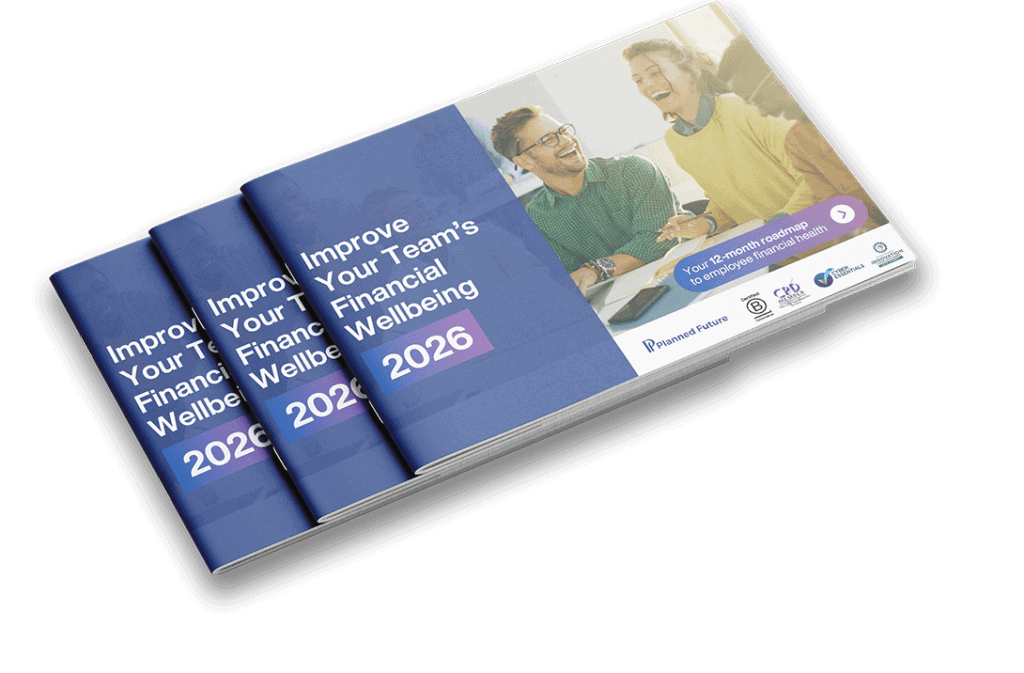
2026 Employee Financial Wellbeing Strategy

Planned Future are workplace wellbeing experts and our 2026 Employee Wellbeing Guide is designed to help you improve outcomes, increase awareness and unlock better performance across your workplace. What’s included:

  • 12-month roadmap with examples
  • How to provide on-demand information, guidance & signposting
  • Measurable data – what to track
  • Employee feedback opportunities
  • Plus much more
 
Complete the form for instant access to your 2026 Employee Financial Wellbeing Guide

Money Guide Service Terms and Conditions

Please read and accept the Terms & Conditions by completing the form at the end of the document. 

  1. INTRODUCTION

This agreement sets out the terms under which our Services are to be provided.

Planned Future Wellbeing Ltd is a leading provider of financial guidance and education. We aim to improve financial literacy for individuals whatever their financial circumstances or status and empower people to make informed, intelligent financial decisions. We offer you an initial 30-minute consultation at a fixed fee which is notified to you at the time of booking. Following our initial discussion, should you decide to book further appointments, the cost for our services is set out in the applicable Email Confirmation.

  1. DEFINITIONS

Ad Hoc Support” means Services that are provided to you on an individual engagement basis.

Email Confirmation” means an email exchange between you and us to confirm the Services to be provided by us to you.

Initial Period” has the meaning given to it in clause 4.

Ongoing Support” means Services that are provided to you on a subscription period basis.

Planned Future”, “we”, “our” or “us” means Planned Future Wellbeing Ltd (company number 09367736).

Privacy Policy” means Planned Future’s privacy policy which is set out on our website here: https://plannedfuture.co.uk/privacy-policy/.

Renewal Period” has the meaning given to it in clause 4.

Services” means the “Money Guide” financial guidance and education services as set out in clause 3 and as more particularly described in the Email Confirmation.

You” and “your” means a client user of the Services.

  1. OUR SERVICE

We will provide financial guidance and education services to you. Financial guidance and education is the process of providing information, signposting, guidance and considering your options on a wide range of financial issues. Our service is impartial. We will not provide any personal recommendations and any investment and/or financial decision made by you will be yours. Where relevant, we will explain the different options available and outline the pros and cons of each. We can provide signposting information to you and provide help with using products and services that are available direct to consumers, but we do so without recommending such products or services. Where appropriate, we can at your request refer you to regulated financial advisers or legal or tax advisers . Every element of our Services is designed to empower you to make your own informed financial decisions, for example understanding your pension scheme options and considering whether you are on track to achieve your financial goals. Following your initial 30-minute consultation, we offer both Ad Hoc Support and Ongoing Support services.

  1. COMMENCEMENT aND TERM

This agreement shall commence on the date that you indicate agreement by email to an Email Confirmation and shall remain in force until terminated in accordance with the Cancellation section below.

Where you have subscribed to Ongoing Support, on the expiry of the initial subscription period (the “Initial Period”) for such Service, this agreement renews automatically for successive periods of such subscription period (each a “Renewal Period”) unless:

  • either party gives the other party not less than 30 days’ notice to terminate prior to the end of the Initial Period or Renewal Period (as applicable), in which case this agreement ends on the expiry of the Initial Period or the then-current Renewal Period (as applicable); or
  • unless terminated earlier in accordance with accordance with Cancellation Section
  1. FEES

Following your initial consultation, should you decide to book further appointments, the fees for our Services are set out in the Email Confirmation.

You must pay the fees for the Services to Planned Future within the period specified in the Email Confirmation or, if no such period is specified, within 7 days following the issue of an invoice by Planned Future.

You must pay the fees by bank transfer or by such other form of payment as agreed by the Planned Future (using such payment details as are notified by Planned Future to you from time to time).

If you do not pay any amount properly due to Planned Future under this agreement and/or an Email Confirmation, Planned Future may charge you interest on the overdue amount at the rate of 3% per annum above the Bank of England base rate from time to time (which interest will accrue daily until the date of actual payment and be compounded at the end of each calendar month).

Changes to fees


We may increase the fees for our Services from time to time by providing written notice to you. If you are an Ongoing Support client, where we do make changes to the fees, those changes will not affect you until your subscription is next due for renewal.

  1. ACCURACY OF INFORMATION


Any guidance and education provided by us will be based on the information that you give to us, so it is vital that you provide us with accurate information about your circumstances and objectives. If you provide inaccurate information to us, it could affect the suitability of the guidance and education given. You agree that we shall have no liability to you in the event that any information you provide to us is inaccurate or misleading.

  1. CANCELLATION


Ad Hoc Support

Where you are a user of Ad Hoc Support services, we may terminate this agreement by giving you at least 10 business days’ written notice. Where you are a user of Ad Hoc Support services, you may terminate this agreement at any time, without penalty. Notice of this termination must be given in writing and will take effect from the date of receipt. Termination is without prejudice to any Services already provided to you. You will be liable to pay for any Services provided to you prior to termination and any fees outstanding, if applicable.


Ongoing Support

Where you are a user of Ongoing Support services, you may terminate this agreement at any time by simply informing us in writing. However we reserve the right to charge you for any unused credits in relation to the remainder of the Initial Period or Renewal Period, whichever is applicable. Termination is without prejudice to any Services already provided to you. You will be liable to pay for any Services provided to you prior to termination and any fees outstanding, if applicable.

  1. DISCLAIMER OF LIABILITY

Financial guidance is not an activity that is regulated by the Financial Conduct Authority, and neither we nor our directors, officers, employees or agents are regulated by the Financial Conduct Authority. Planned Future will not offer any advice that is regulated or conduct any other regulated activity, including without limitation holistic advice, simplified advice, advising on which funds to invest in, which mortgage or insurance products to purchase or whether or not to transfer a pension. This means that it is your responsibility to ensure that the actions you take as a result of our financial guidance are right for you. You will not be covered by the government’s Financial Services Compensation Scheme with respect to our Services or by Planned Future if something goes wrong.

If you require regulated services, we may at your request notify a third party of your requirements and refer you to such third party individual or organisation that offers or provides regulated financial advice. If you have more complex needs such that the Services are not suitable, then we may help you find a suitable third party adviser for such needs.

We are not responsible for any guidance, advice or recommendations given to you by a third party adviser, including any third party financial advisers you are referred to by us. If you choose to speak to a third party adviser, you will have to agree to their terms and conditions which are independent of and separate to the terms of this agreement you have with us.

Except for any liability arising from (a) death or personal injury caused by negligence; or (b) fraud or fraudulent misrepresentation; or (c) any other matter for which it would be illegal or void at law for a party to limit or exclude its liability, we exclude and do not accept any liability to you in connection with any loss or damage caused, or alleged to have been caused, directly or indirectly, by the guidance, information, signposting  or options contained, considered or referenced in the Services.

You acknowledge that you take full responsibility for your finances and well-being, as well as the finances and well-being of your family and all financial decisions now or in the future. We are not responsible for any financial decisions or funding decisions that you make, or which you fail to make. You hereby waive any and all claims against us, our directors, officers, employees and agents in relation to the Services or the consequences that may occur as a result of following the guidance, information, signposting or options given under this agreement.


Complaints

If you are dissatisfied with the Services we have provided, you are entitled to make a complaint. We have a complaints procedure that is available on request. If you wish to register a complaint, please contact us:


In writing:                 John Chadwick

Planned Future Wellbeing Ltd

Suite 3, 3rd Floor, Refuge House

Watergate Row South

Chester, England, CH1 2LE

By phone:                 +44 (0) 344 9672567

By email:                   john@plannedfuture.com

Please be assured we treat all complaints seriously and we will endeavour to respond to a complaint within thirty (30) days of receipt of the complaint.  

  1. DATA PROTECTION

To provide the Services properly, we will need to collect information about your personal and financial circumstances. We will only use your personal information to deliver the Services. Full details of what information is collected by us and how it is used can be found in our Privacy Policy. By using the Services and/or agreeing to this agreement, you accept our practices regarding personal data and how it will be treated.

We will never share your data or information with any other third party except when it is directly required to provide the Services you have requested or where you have given us explicit permission in advance.

We shall use appropriate safeguards to maintain the privacy and security of your personal data, as further outlined in our Privacy Policy.

Under data protection laws, you have the following rights:

  • You can ask us for a copy of the personal information we hold about you. We will provide this free of charge, unless your request is repetitive or excessive, in which case we reserve the right to charge you a reasonable fee.
  • You can inform us of any changes to your personal information, or of any corrections you would like them to make to any of the personal information we hold about you.
  • In certain situations, you can ask us to erase the personal information we hold about you, or object to particular ways in which we are using your personal information. Please note that we may need to retain certain information for recordkeeping purposes, to complete any Services that have begun prior to your request, or for other purposes as required or permitted by applicable law.
  • Where we are using your personal information on the basis of your consent, you are entitled to withdraw that consent at any time.
  • Where we process your personal information based on legitimate interest or the public interest, you have the right to object at any time to that use of your personal information.

You may exercise any of the rights set out in the paragraph above by writing to us (by email or by post).  For security reasons we may ask for proof of your identity before disclosing information about you, or to you, via email or over the telephone.

  1. GENERAL


Amendments


From time to time it may be necessary to amend the terms set out in this agreement. If this is the case we will write to you with details of the changes at least thirty (30) days before the amended terms take effect. Your continued use of the Services shall be deemed to constitute its acceptance of any such revised terms.


Communicating with you

We may communicate with you by telephone, post, email or in person. All our communications with you will be in English.


Miscellaneous

If any provision or part-provision of this agreement is or becomes invalid, illegal or unenforceable, it will be deemed modified to the minimum extent necessary to make it valid, legal and enforceable. If that modification is not possible, the relevant provision or part-provision will be deemed deleted. Any modification or deletion under this clause does not affect the validity or enforceability of the rest of this agreement.


Jurisdiction

This agreement is governed by and should be interpreted in accordance with English law and you agree to submit to the non-exclusive jurisdiction of the English Courts.


Legal and accounting advice

Neither we nor our directors, officers, employees or agents are qualified to render legal or accounting advice or to prepare any legal or accounting documents. It is hereby understood and agreed that the onus is on you, the client, to refer to a solicitor or accountant any point of law or accountancy that may arise during the course of discussions with us.

  1. YOUR CONSENT


These are our standard client terms and conditions upon which we intend to rely. For your own benefit and protection, you should read these terms carefully before indicating your agreement to an Email Confirmation. If you do not understand any point, please ask for further information.